An Inconspicuous Army

The Last Prayer

Hundreds of people, many of whom I have never met (and never will meet), who knew nothing about me except my name, from all over the world, since long before I was born. Some much poorer than I, some dealing with much graver loss or illness—in much greater need of my prayers than I of theirs. Some who never found out that their prayers for me were answered. Some who died long before their prayers for me were answered.

Everywhere—in dining rooms, living rooms, basements, churches, high school auditoriums, offices, shopping malls, parks, cars, planes—walking, standing, sitting, kneeling, prostrate, in bed half-asleep—in groups, in pairs, all alone. For a second or two—for a minute or two—for hours—for years on end.

It’s the old women’s prayers that get to me most: the tiny prayers of tiny women in tiny apartments with tiny jobs—and terrible perfumes—and endless hearts. Hundreds of them over the years, women with uncomplicated souls, better souls than mine.

And of course I cannot prove that any of their prayers made any difference. (How could anyone ever prove—or disprove—such a thing?) But to pray is to stand in solidarity with those who pray, and with those who are prayed for. And so I still often weep at the thought of the inconspicuous army of known and unknown saints who have prayed for me.

We Demand Windows

7 of the Most Famous Stained Glass Windows in the World

We demand windows. Literature as Logos is a series of windows, even of doors. One of the things we feel after reading a great work is ‘I have got out’. Or from another point of view, ‘I have got in’; pierced the shell of some other monad and discovered what it is like inside.

Good reading, therefore, though it is not essentially an affectional or moral or intellectual activity, has something in common with all three. In love we escape from our self into one other. In the moral sphere, every act of justice or charity involves putting ourselves in the other person’s place and thus transcending our own competitive particularity. In coming to understand anything we are rejecting the facts as they are for us in favour of the facts as they are. The primary impulse of each is to maintain and aggrandise himself. The secondary impulse is to go out of the self, to correct its provincialism and heal its loneliness. In love, in virtue, in the pursuit of knowledge, and in the reception of the arts, we are doing this. Obviously this process can be described either as an enlargement or as a temporary annihilation of the self. But that is an old paradox; ‘he that loseth his life shall save it’. … The man who is contented to be only himself, and therefore less a self, is in prison. My own eyes are not enough for me, I will see through those of others. Reality, even seen through the eyes of many, is not enough. I will see what others have invented. Even the eyes of all humanity are not enough. I regret that the brutes cannot write books.

CS Lewis, An Experiment in Criticism

Day Bidet #54

presbyterian church abandoned alabama forgotten sky
Adams Grove Presbyterian Church, Sardis, Alabama

All that you suffered, all the disease, you couldn’t hide it, hide it from me:

  1. “[T]he antidote to foreboding joy … are the practices of gratitude.”
  2. “[C]hildren born during the pandemic have significantly reduced verbal, motor, and overall cognitive performance compared to children born pre-pandemic.” (Related. Related: “[T]hese estimates suggest between 72,000 and 180,000 … vaccine-induced deaths in the U.S. during the experimental COVID-19 vaccination program.” Related. Related.)
  3. “In Western philosophy, natural theology goes back to the very beginning, to the Greeks—and not just to Plato and Aristotle, but to the Pre-Socratics.”
  4. Trust the science! Just not the scientists. (Related.) Or the newscasters.
  5. McGrew contra credentialism.
  6. The Democratic Party is no longer the party of the working class. (Duh—no political party has ever truly been the party of the working class.)
  7. Craig Keener on 1 Peter.

More:

“[T]he internet is purposefully being changed to make you miserable.” (But it does still have its moments, some of which are quite beautiful and relaxing.)

“[L]et us clothe ourselves with spiritual fire.”

What are they implying??

Hester Cholmondeley: “Still as of old / Men by themselves are priced— / For thirty pieces Judas sold / Himself, not Christ.”

Ron Highfield’s Rethinking Church

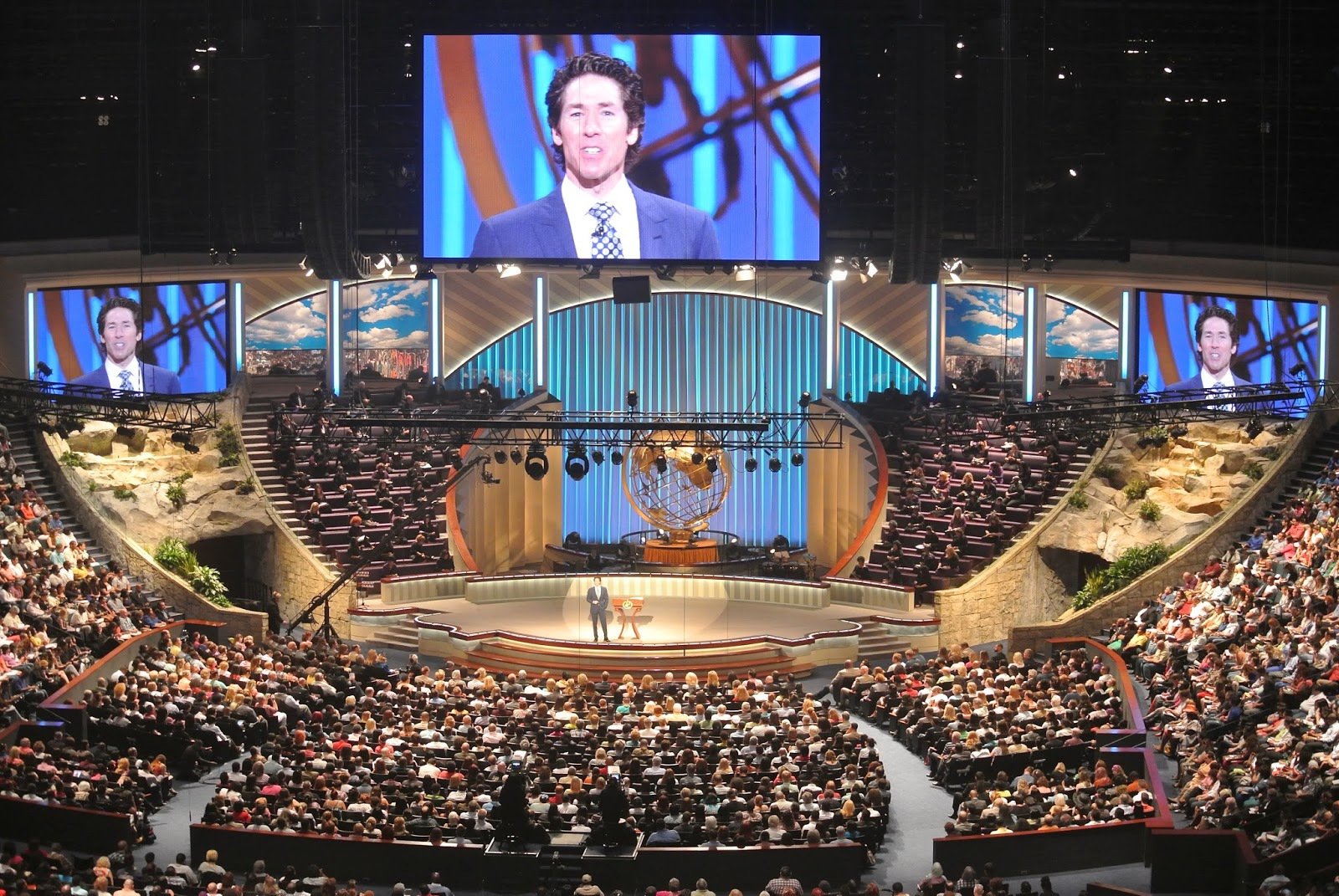
Are mega churches just businesses masquerading as worship? – Film Daily

Quick read. Highly recommended. Some of my highlights:

[T]he traditional way churches organize themselves is the major obstacle to embodying authentic church life in the world…. A church may burden itself with so many and such extraneous accidental features that it becomes almost impossible to live out its essence.

[A]ssociations tend to stray from their founding purposes…. It is common, even expected, that associations supposedly devoted to education, a sport, a profession, or a particular subject will make resolutions and public proclamations on divisive political and social issues completely unrelated to their reason for existence. Not all mutinies occur on ships. Not all pirates sail the seas.

Later generations [of church leaders] … may begin to preserve the traditions of earlier days simply to safeguard their positions in a bureaucracy.

If [the state] leaves the church alone, if it recognizes its freedom to worship as it pleases, to organize as it sees fit, to choose its own leaders, and if it grants such privileges as tax-exempt status, it does so only because it judges that the church does not work against the essential interests of the state. … The church always faces the temptation to hold on to its freedoms and privileges by subordinating, compromising, or giving up its mission of witnessing to the lordship of Jesus Christ. … When churches operate like other institutions in society they place themselves under the ethics, laws, and social expectations applicable to analogous institutions.

I do not think that the status quo can be maintained for much longer. … [The church] can try to prove its continued relevance to society by adapting to society’s progressive morality while deceiving itself into thinking that this new morality is thoroughly Christian. In contrast, the church can give up its vain ambition to be recognized as chaplain and advisor to an increasingly pagan culture and take up its original mission as a countercultural witness to Christ.

“[P]arachurches” … conduct their work in ways that require a constant stream of revenue. They purchase and maintain building complexes, making it necessary to hire janitors, make periodic repairs, and pay large utility bills. To coordinate the activities of hundreds of people and programs for every age and interest group, churches must hire five, ten, or even twenty-five ministers. The Sunday worship alone requires the service of a worship minister, sound and lighting technicians, singers, and several band or orchestra members. … Even a medium-sized church needs an annual budget of $800,000 to $1,000,000. Megachurches need $10,000,000 to $50,000,000 annually.

And from where does this money come? It comes from member donations. And why do they give? … Some churches teach explicitly and others implicitly that giving to the church is a Christian duty or even a quasi-sacrament. … Or, we think of our gifts as membership dues. We attend church services, enjoy the pageantry and an uplifting message from a gifted speaker, and benefit from the work of staff and volunteers. We feel guilty if we attend without helping to pay for the services.

But money exerts a corrupting force. Churches have earned a reputation for constantly soliciting donations…. Churches need to meet their annual budgets. The staff’s livelihood and the viability of many programs depend on it. … If we set up the church so that we need to attract customers and keep them happy, how can we at the same time call them to “count the cost” of following Jesus (Luke 14:15-35)?

[W]hen i became an employee of a church my duty to God got confused with the expectations of my employer…. If your service to God becomes a means of livelihood on which your family depends for mortgage payments, school loan payments, and retirement savings, the joy of ministry often departs. You begin to think about salary, benefits, and working conditions. You notice who has power over you and who does not. … [A]fter a few years ministers are tempted to think of their ministries as they would other jobs, as means of livelihood.

If you gather around a table to share a meal, read the Scriptures, and pray for each other, you do not need a highly skilled speaker, a talented worship leader, an efficient administrator, or a meticulous bookkeeper. … In an assembly of 2,000 people, 1,950 will be completely unknown to us. For most of the time, we sit in rows looking at what is happening on stage. Senior pastors are like the celebrities we see on the screen. We feel like we know them, but we have never had a meal with them. In a small gathering we can hear from everyone, we can learn their stories, see their faces, and hear their voices.

If faith is to survive we must intentionally retreat to places where the Christian story is repeated and lived.

[P]reachers spend what time they have left after doing their administrative duties searching for hooks, movie clips, pictures, and stories rather than studying the Scriptures…. [F]or all that work, the modern sermon contains little instruction on the true scope and depth of the Christian faith. Nor does it really challenge the deep pagan myths that animate our post-Christian culture. … I do not think listening to a twenty-minute uplifting talk on Sunday morning will repair a half-century of neglect. We may have to do something more radical.

[W]hen an individual actually urges churches modeled on businesses, schools, charitable organizations, theaters, or community centers to return to the family or kingdom or the body of model of the church, the systemic logic of these models absorbs, overwhelms, and neutralizes all efforts at reform. At work in each of these models is an irresistible logic fundamentally at odds with the essential nature and mission of the church. … [Y]ou cannot reform the traditional church by tweaking this or that program or renaming an office or an activity to sound more biblical…. True reform begins with abandoning the foundational logic of alien models and all their outward manifestations. The problem is in the DNA, not in the name.

[M]ost contemporary churches are stage centered. People come to watch, listen, and feel. The preachers, readers, worship leaders, musicians, and singers are the center of attention. The church experience becomes performance and entertainment. If the performance is not satisfactory, we go elsewhere. … The stage replaces the table, the music replaces the Eucharistic meal, and a general feeling of transcendence replaces Christ crucified and risen. … [I]f there is any institution that reeks of inauthenticity, it is the institutional church. … Authenticity is not trendiness but honesty. It is having no gimmicks and playing no tricks. No plastic smiles, fake happiness, or implausible certainty.

The question for me is not “Why seek God?” The question is “Why seek anything else?”

What Christianity Offered

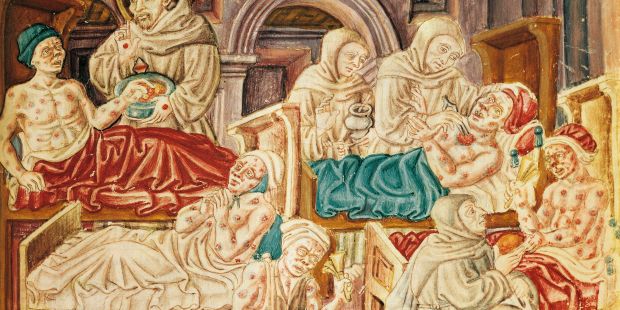
HOSPITAL; MIDDLE AGES; CHRISTIAN; LEPROSY

To cities filled with the homeless and impoverished, Christianity offered charity as well as hope. To cities filled with newcomers and strangers, Christianity offered an immediate basis for attachments. To cities filled with orphans and widows, Christianity provided a new and expanded sense of family. To cities torn by violent ethnic strife, Christianity offered a new basis of solidarity. And to cities faced with epidemics, fires, and earthquakes, Christianity offered effective nursing services.

Rodney Stark, The Rise of Christianity: How the Obscure, Marginal Jesus Movement Became the Dominant Religious Force in the Western World in a Few Centuries

Day Bidet #53

Christ is in the shape-up, he’s in the hatch, he’s in the union hall:

  1. Berryman: “Unite my various soul, / sole watchman of the wide & single stars.” King David: “[U]nite my heart to fear Thy name.”
  2. “I have never known silence like I found in the village where almost an entire generation of their young had been killed simply because a pilot had missed.” (Related. Related: “‘National security’ is a euphemism for ‘world domination.'” Related: You can’t trust the experts.)
  3. “[B]etween 50,000 and 70,000 Christians have been killed in Nigeria in the last decade.” (Related: “[M]ost expect to meet Jesus face to face in the next two weeks.”)
  4. Where’s the lie? Where’s the lie? Where’s the lie? Where’s the lie? Where’s the lie? (Language warning.) Where’s the lie? Where’s the lie?where’s the lie???
  5. “[I]f we wish to start living where we are … we too will need something of the loyalty of children and the great patience of poets.”
  6. “We got the tortured animals & the reanimated corpses & the kidnapped children, but the flying cars & wonder drugs are still, as always, ten years out.” (Language warning. Related.)
  7. “The soul is like a wild animal.”

More:

Whoops! (Related—not that you should be at all amazed.)

“Romans would have cost over 2,000 dollars.”

“Plants already account for 82% of kcal and 60% of protein. But in many regions of the world, #animalproducts can improve food security, nutrition, agroecosystems and efficiency.” (Related. Related.)

Psalm 90.1: “Lord, Thou hast been our dwelling place in all generations.”

Loving Less

The way to love foreigners more is not to love your countrymen less. And the way to love your countrymen more is not to love foreigners less. The way to love your neighbor more is not to love your enemy less.

The way to love the present more is not to love the past less. The way to love the past more is not to love the present—or the future—less.

The way to love the poor more is not to love the rich less. The way to love criminals more is not to love victims less. The way to love victims more is not to love criminals less.

The way to love animals more is not to love human beings less.

The way to love George Floyd more is not to love Derek Chauvin less. The way to love Derek Chauvin more is not to love George Floyd less.

The way to love your brothers in Christ more is not to love unbelievers less. The way to love unbelievers more is not to love your brothers in Christ less. The way to love holiness more is not to love sinners less. The way to love sinners more is not to love holiness less.

The way to love sacrifice more is not to love God’s gifts less.

The way to love God more is not to love anyone or anything in His creation less. On the contrary: “Love of Thee / Swells all loves as mighty floods / Swell all streams.” God is Love, and so loving less is never the way.

You Can’t Trust the Experts: COVID-19, Part I

“The most vaccine-hesitant group of all? PhDs”

Just in case you weren’t already aware: You can’t trust the experts when it comes to COVID.

Here‘s a helpful rundown (apologies for the crassness and vulgarity). And Locklin doesn’t even mention that “Pfizer crossed its published benchmark before Election Day, but didn’t want to have to announce its results, so it shut down its lab work on [its COVID-19 vaccine].” Nor does he fully dive into the media’s role in everything (nor the geopolitical angle).

“[S]ubmission works in stages. If you submit to this small thing, what next will you submit to?” Don’t submit to faceless institutions which have not earned your trust. Submit to God and in “secular” matters think for yourself.

Related. Related.

Day Bidet #52

Perfect love casteth out fear:

  1. “In 2020, Americans spent an average of 5.53 hours a day on leisure and sports and about 0.09 hours … on religious and spiritual activities.”
  2. Live not by lies.
  3. “[W]hat is the function of these genealogies in Genesis?”
  4. “Probably the most important graph for health, ever.” (So lift weights, cut carbs and processed foods, and eat red meat! Related. Related. Related.)
  5. Alcoholic milk. (Related.)
  6. HODL Bitcoin. (Related. Related. Related. Related: “The global medium of exchange as we know it is also a medium of social control.” Related. Related.)
  7. “New Testament scholars are far too ready to assume that the evangelists, and John in particular, felt free to put words into Jesus’ mouth if they thought that something was what he would have said and was consonant with his other teaching. But this is not what we find in John. Instead, when John has some interpretation to give his readers, he distinguishes his own interpretation from what Jesus actually says.”

More:

Alexander Crummell: “Let our posterity know that we their ancestors, uncultured and unlearned, amid all trials and temptations, were men of integrity.”

“Feeling During Modern Worship Concert Suspiciously Similar To Feeling During Rock Concert.” (Relatedpreviously on DBD. Lol.)

Clown World. Clown World. Clown World. Clown President. (Related—and prescient. Related. Related. Related. Related. Related.) But this takes the cake. Demon World (and yes, someone should have seen it coming). Demon World. Demon World (so homeschool your kids!). But still, a lovely, lovely world if you know where to look.

“Prince of the world and Lord of the flies.”

Go to My Brothers

Fra Angelico, Cattura di Cristo (The Capture of Christ)

And they all left him and fled.

Mark 14.50 (ESV)

Jesus said to her, “Do not cling to me, for I have not yet ascended to the Father; but go to my brothers and say to them, ‘I am ascending to my Father and your Father, to my God and your God.'”

John 20.17 (ESV)

Sermons on the interval of time between Jesus’ death and his appearances to his disciples usually stress the disciples’ fear, disillusionment, and uncertainty after the crucifixion. What they do not usually stress is their shame.

And yet it is not only Peter who boasts, “If I must die with you, I will not deny you” (Mark 14.31; ESV). And it is not only Peter who deserts Jesus and denies him: “And they all left him and fled.” All of the disciples left Jesus and fled, and he was taken away, and the next day was dead and gone.

And of course Jesus knows all along that his friends will desert him in his hour of greatest need. Which makes his greeting upon being reunited with them all the more striking: “Peace be with you” (John 20.19).

Even more striking, however, are his instructions to Mary Magdalene beforehand:

Not to my betrayers, nor my servants, nor even my friends—

Go to my brothers.