The brief glow fell upon a huge sitting figure, still and solemn as the great stone kings of Argonath. The years had gnawed it, and violent hands had maimed it. Its head was gone, and in its place was set in mockery a round rough-hewn stone, rudely painted by savage hands in the likeness of a grinning face with one large red eye in the midst of its forehead. Upon its knees and mighty chair, and all about the pedestal, were idle scrawls mixed with the foul symbols that the maggot-folk of Mordor used.
Gustav Doré, “Le sermon sur la montagne” (“The Sermon on the Mount”)
There is a sort of notion in the air everywhere that all the religions are equal because all the religious founders were rivals, that they are all fighting for the same starry crown. It is quite false. The claim to that crown, or anything like that crown, is really so rare as to be unique. Mahomet did not make it any more than Micah or Malachi. Confucius did not make it any more that Plato or Marcus Aurelius. Buddha never said he was Bramah. … The truth is that, in the common run of cases, it is just as we should expect it to be…. Normally speaking, the greater a man is, the less likely he is to make the very greatest claim. Outside the unique case we are considering, the only kind of man who ever does make that kind of claim is a very small man; a secretive or self-centered monomaniac. Nobody can imagine Aristotle claiming to be the father of gods and men, come down from the sky; though we might imagine some insane Roman Emperor like Caligula claiming it for him, or more probably for himself. Nobody can imagine Shakespeare talking as if he were literally divine; though we might imagine some crazy American crank finding it as a cryptogram in Shakespeare’s works, or preferably in his own works. It is possible to find here and there human beings who make this supremely superhuman claim. It is possible to find them in lunatic asylums; in padded cells; possibly in strait waistcoats. … [A delusion of divinity] can be found, not among prophets and sages and founders of religions, but only among a low set of lunatics. But this is exactly where the argument becomes intensely interesting; because the argument proves too much. For nobody supposes that Jesus of Nazareth was that sort of person. No modern critic in his five wits thinks that the preacher of the Sermon on the Mount was a horrible half-witted imbecile that might be scrawling stars on the walls of a cell. No atheist or blasphemer believes that the author of the Parable of the Prodigal Son was a monster with one mad idea like a cyclops with one eye. Upon any possible historical criticism, he must be put higher in the scale of human beings than that. Yet by all analogy we have really to put him there or else in the highest place of all. … If Christ was simply a human character, he really was a highly complex and contradictory human character. For he combined exactly the two things that lie at the two extremes of human variation. He was exactly what the man with a delusion never is; he was wise; he was a good judge. What he said was always unexpected; but it was always unexpectedly magnanimous and often unexpectedly moderate. Take a thing like the point of the parable of the tares and the wheat. It has the quality that unites sanity and subtlety. It has not the simplicity of a madman. It has not even the simplicity of a fanatic. It might be uttered by a philosopher a hundred years old, at the end of a century of Utopias. Nothing could be less like this quality of seeing beyond and all round obvious things, than the condition of the egomaniac with the one sensitive spot on his brain. I really do not see how these two characters could be convincingly combined, except in the astonishing way in which the creed combines them. For until we reach the full acceptance of the fact as a fact, however marvellous, all mere approximations to it are actually further and further away from it. Divinity is great enough to be divine; it is great enough to call itself divine. But as humanity grows greater, it grows less and less likely to do so. God is God, as the Moslems say; but a great man knows he is not God, and the greater he is the better he knows it. That is the paradox; everything that is merely approaching to that point is merely receding from it. Socrates, the wisest man, knows that he knows nothing. A lunatic may think he is omniscience, and a fool may talk as if he were omniscient. But Christ is in another sense omniscient if he not only knows, but knows that he knows.
Edwin Forbes, Pickett’s Charge from a position on the Confederate line looking toward the Union lines, Ziegler’s Grove on the left, clump of trees on right
It’s all now you see. Yesterday won’t be over until tomorrow and tomorrow began ten thousand years ago. For every Southern boy fourteen years old, not once but whenever he wants it, there is the instant when it’s still not yet two o’clock on that July afternoon in 1863, the brigades are in position behind the rail fence, the guns are laid and ready in the woods and the furled flags are already loosened to break out and Pickett himself with his long oiled ringlets and his hat in one hand probably and his sword in the other looking up the hill waiting for Longstreet to give the word and it’s all in the balance, it hasn’t happened yet, it hasn’t even begun yet, it not only hasn’t begun yet but there is still time for it not to begin against that position and those circumstances which made more men than Garnett and Kemper and Armistead and Wilcox look grave yet it’s going to begin, we all know that, we have come too far with too much at stake and that moment doesn’t need even a fourteen-year-old boy to think This time. Maybe this time with all this much to lose and all this much to gain: Pennsylvania, Maryland, the world, the golden dome of Washington itself to crown with desperate and unbelievable victory the desperate gamble, the cast made two years ago; or to anyone who ever sailed a skiff under a quilt sail, the moment in 1492 when somebody thought This is it: the absolute edge of no return, to turn back now and make home or sail irrevocably on and either find land or plunge over the world’s roaring rim.
William Faulkner, Intruder in the Dust
On this day in 1863, the Battle of Gettysburg came to an end. It remains the deadliest battle in American history.
My shortcomings are very serious; they are unpardonable. I am ashamed, but I beg you nevertheless to continue helping me correct my fault[s]. My mistakes show that I have not understood the aim of the great Cultural Revolution and that I don’t have enough love for Mao. All my life I must study Mao’s sayings with determination and love the Party with all my heart.
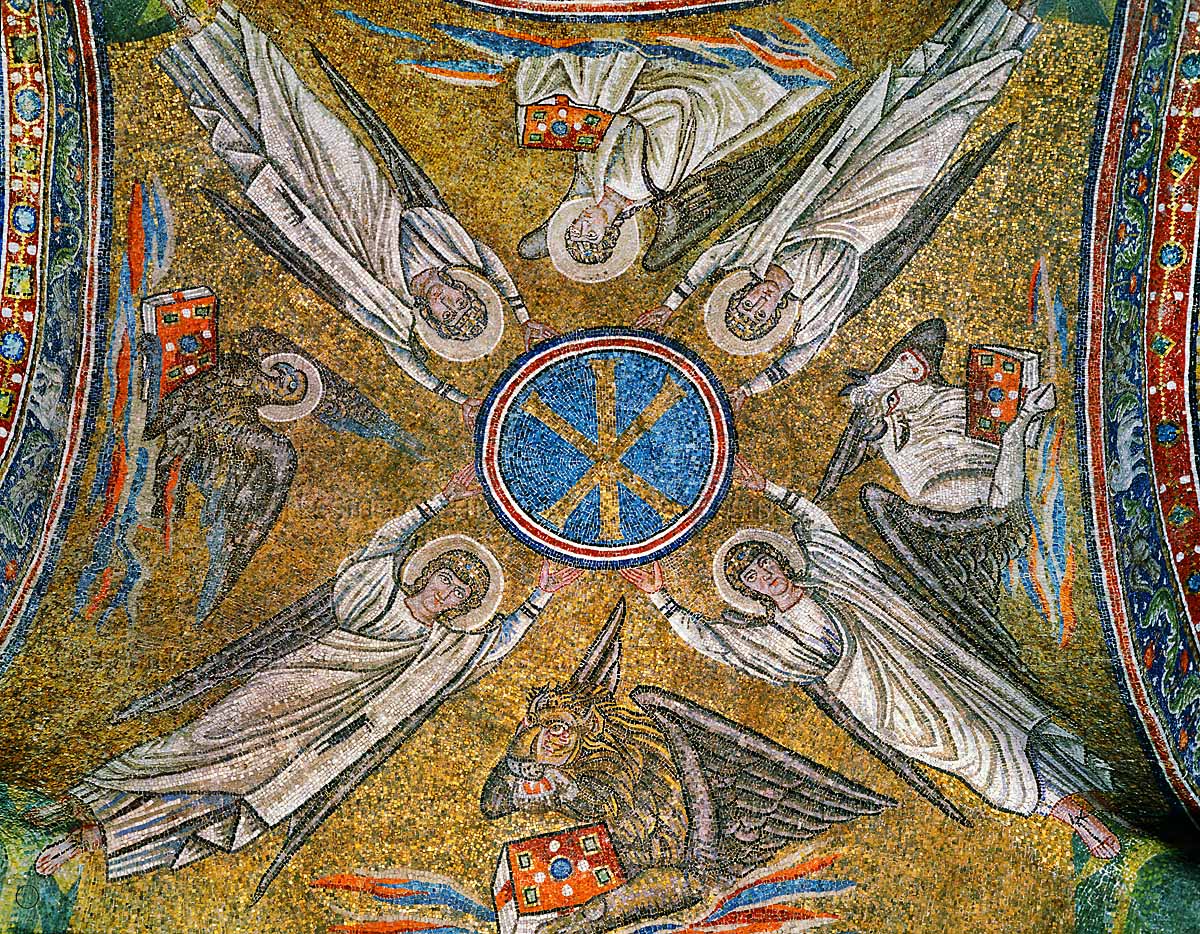
A sixth-century mosaic from the Basilica of San Vitale at Ravenna
The nature and personality of Jesus are clearly the same in all four Gospels. … His use of sarcasm, his modes of thought, his rapier-sharp wit, his love for his friends, his weeping with compassion, his ability to read thoughts, even his characteristic metaphors and turns of phrase, his use of object lessons. John’s presentation of Jesus is actually very strikingly the same as the synoptics. And the differences between them are exaggerated and incorrectly stated by critical scholarship. By the use of vivid vignettes, John shows us not an allegorical abstraction but a solid and intensely real person, and he is the same person we meet in the synoptic Gospels. And we can tell that by reading them. That’s not just something we believe by faith. That’s actually right there in the text and in the documents.
Politics is war, and war is as old as mankind (or chimpanzeekind). But hate hoaxes are relatively new. What can they teach us about how political war works?
In real war, with swords or guns, you generally want your side to appear as strong and intimidating as possible. Your goal is to scare your enemy.
In American political war today, you generally want your side to appear as weak and oppressed as possible. Your goal is to demonize your enemy.
And with that goal in mind, hate hoaxes make perfect sense. A hate hoax makes you look weak and oppressed and your enemy, well, hateful. It makes you look like the victimdeserving of sympathy—and validates your anger and retaliation against anyone who opposes you.
Hate hoaxes, in other words, exaggerate your enemy’s hatred and power. And in political war, exaggerating your enemy’s hatred and power is the smart thing to do. Most people are anti-hate, so if you can successfully portray your enemy as a hateful oppressor, you can get most people to turn on him. You can make him the target of their outrage and indignation (and hatred). And then you’ve won the political war.
Especially if you’re the Blue Establishment. There are hate hoaxes on both sides (and genuine hatred on both sides), but Blue is the Establishment, Blue dominates American culture, and Blue’s morality is victim morality, so only Blue has been able to turn its hate hoax into a full-fledged Narrative and worldview.
We’re all familiar with the Blue Narrative because, well, we’re all living in it. It’s the hate hoax according to which whites/men/Christians/cops are exclusively and systematically oppressing nonwhites/women/non-Christians/criminals. The Blue Narrative is a hoax not because no such oppression exists—white men have done plenty of awful things throughout history—but because it shamelessly distorts and exaggerates. Which is why millions of Americans are protesting a police brutality “epidemic” which simply does not exist.
(How many unarmed black men would you guess were killed by the police in 2019? Hundreds? Thousands? The answer: as few as nine—and of course the number of unjustified killings is even lower. But the Establishment has convinced half the country that a genocideis underway because it wants us hysterical and under its control.)
(Final case study: Have you seen any recent video or photographic evidence of roving bands of “white supremacists” doing anything like this, this, or this—not to mention this? If not, then consider the possibility that you are being lied to about the nature of hatred, violence, and crime in America.)
The truth is that America in 2020 is about as unoppressive a place as has ever existed for nonwhites, women, and non-Christians, and that Reality is much more nuanced than the Blue Narrative admits (and often the opposite of what the Narrative says). The truth is that the Establishment is not ignorant Trump supporters but rich people in Washington, New York, and San Francisco—not white men in general (many of whom are profoundly unprivileged) but woke Blues.
The Establishment, however, has done everything in its power to get you angry at the Great White Bogeyman instead of at it, because the the actual people with actual power want your anger directed at scapegoats (white people, men, cops, “racists”) rather than at them. It’s not hard to see why: The more the powers of this world can control your worldview and anger, the more they can control you.
But I don’t want to be controlled by anyone but God or hysterical and unhealthily angry. I want to be rational and free. For me, and for most of us, that means erring on the side of being less angry, for at least two reasons. The first is that anger is generally bad for you:
Of the Seven Deadly Sins, anger is possibly the most fun. To lick your wounds, to smack your lips over grievances long past, to roll over your tongue the prospect of bitter confrontations still to come, to savor to the last toothsome morsel both the pain you are given and the pain you are giving back—in many ways it is a feast fit for a king.
The chief drawback is that what you are wolfing down is yourself.
The skeleton at the feast is you.
Frederick Buechner, Wishful Thinking: A Theological ABC
The second is that clamping down on anger is a necessary step to seeing the world clearly. It keeps us from rushing to judgment when we hear about the latest incident (which may be a hate crime or a hate hoax—or just an honestmistake). And it allows us to see through the Blue Narrative—or any other narrative—and understand Reality for what it truly is: something quite different from the hate hoax in which we currently live.
[S]ince biblical scholarship has taken up a home primarily in the academy (where learned people speak and write to impress other learned people) rather than in the church (where holy people speak and write to transform others), it is peculiarly susceptible to academic chicanery.
Over the course of my career, I have seen wave after wave of theoretical keys promising to unlock the ancient texts: existentialism, psychology (Freudian, Jungian, Adlerian), structuralism (Marxism of some form or another), post-structuralism (whether Derridean or Foucaultian), the anthropology of honor and shame. They have all over-promised and under-delivered, for they have all missed the heart of the literature, which is religious thought about life before God.
[…]
My problem is with first-world academics using “post-colonialism” as just one more in a series of theoretical perspectives that have, at best, a very limited usefulness in understanding the New Testament. In the case of Paul, in particular, as I have tried to show, all social conditions are adiaphora, and all humans are called to be slaves of God. Paul is not concerned with moving around the furniture of social arrangements. He is much more radical than that. He is concerned with humans being transformed in their very existence so that they can share in the life of God.
Political/economic ideology is the religion of modernity. Like the adherents of traditional religion, many people find comfort in their political worldview, and greet critical questions with pious hostility. Instead of crusades or inquisitions, the twentieth century had its notorious totalitarian movements. “The religious character of the Bolshevik and Nazi revolutions is generally recognized,” writes Hoffer. “The hammer and sickle and the swastika are in a class with the cross. The ceremonial of their parades is as the ceremonial of a religious procession. They have articles of faith, saints, martyrs and holy sepulchers.”
Bryan Caplan, The Myth of the Rational Voter: Why Democracies Choose Bad Policies
It is easy to recognize the religious character of Bolshevik and Nazi ideology. But of course American Progressivism and nationalism have their own parades, articles of faith, saints, martyrs, and holy sepulchers. Are they any less religious?
It is easy to behold the mote in the Nazi’s eye—harder to consider the beam in our own eye and to ask whether our own political ideologies are any more compatible with Christianity (and Reality) than Bolshevism and Nazism.
But the question must be asked how and why and to what extent Progressivism or nationalism (or moderation, or withdrawal from political life, or anything else) is compatible with the faith. Otherwise, we risk fighting on the wrong side of America’s holy civil war—or fighting on the right side (if there even is a “right side”) in the wrong way.








 Brave Ole World