
Day Bidet #48


They cannot conquer for ever:

  1. “We would cheerfully be cowards if that would acquire us a reputation for bravery.” (Related.)
  2. “Since roughly the year 2000 … Democrats have moved significantly to the left on most hot button social issues while Republicans have moved only slightly right.” (Related: “Relativism is a position you employ when you’re weak, to be abandoned when you win.” Related: “You just apply the same formula to every single thing you can find.”)
  3. “‘We’ signals not simply any eyewitness source but the author’s presence.” (Related.)
  4. Homeschool your kids. Homeschool your kids. Homeschool your kids. (Related.)
  5. “Never had it been known for a royal house to be dethroned, exiled—and then re-established. How would a son from the House of David ever arise again who could establish an international empire?”
  6. Thread. (Related: “Pop Science(tm)” has become a “folk religion.” Related.)
  7. CS Lewis: “Every square inch, every split second is claimed by God, and counterclaimed by Satan.”

More:

HODL Bitcoin, save the planet.

“Jesus is saying that his theological opponents believe that the old forms of Jewish religion are actually better than the new wine he is bringing.”

“Homicides in the first quarter of 2021 were 24 percent higher than during the same period in 2020, and 49 percent higher than in the first quarter of 2019.”

Ephesians 6.17-18: “And take the helmet of salvation, and the sword of the Spirit, which is the word of God: praying always with all prayer and supplication in the Spirit, and watching thereunto with all perseverance and supplication for all saints.”

P.S. Pray for South Africa and Haiti, among (many) others.
Lewis on Love of Pets

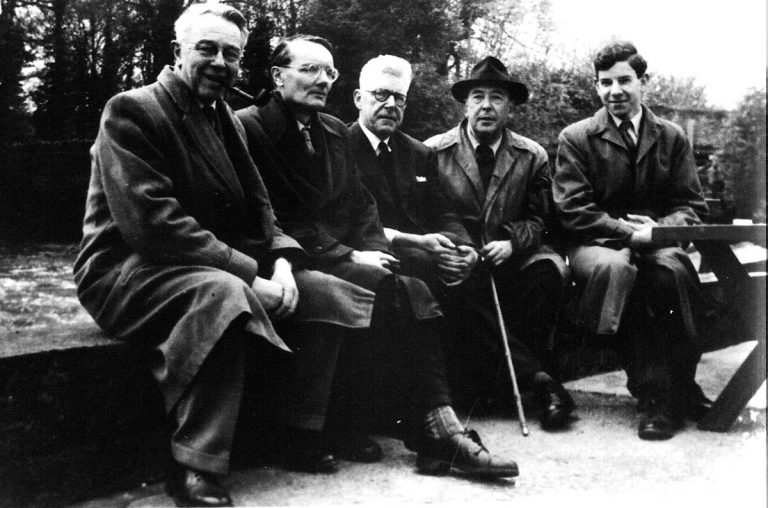
The Inklings.

This terrible need to be needed often finds its outlet in pampering an animal. To learn that someone is “fond of animals” tells us very little until we know in what way. For there are two ways. On the one hand the higher and domesticated animal is, so to speak, a “bridge” between us and the rest of nature. We all at times feel somewhat painfully our human isolation from the sub-human world—the atrophy of instinct which our intelligence entails, our excessive self-consciousness, the innumerable complexities of our situation, our inability to live in the present. If only we could shuffle it all off! We must not—and incidentally we can’t—become beasts. But we can be with a beast. It is personal enough to give the word with a real meaning; yet it remains very largely an unconscious little bundle of biological impulses. It has three legs in nature’s world and one in ours. It is a link, an ambassador. Who would not wish, as Bosanquet put it, “to have a representative at the court of Pan”? Man with dog closes a gap in the universe. But of course animals are often used in a worse fashion. If you need to be needed and if your family, very properly, decline to need you, a pet is the obvious substitute. You can keep it all its life in need of you. You can keep it permanently infantile, reduce it to permanent invalidism, cut it off from all genuine animal well-being, and compensate for this by creating needs for countless little indulgences which only you can grant. … Dogs are better for this purpose than cats: a monkey, I am told, is best of all. Also it is more like the real thing. To be sure, it’s all very bad luck for the animal. But probably it cannot fully realise the wrong you have done it. Better still, you would never know if it did. The most down-trodden human, driven too far, may one day turn and blurt out a terrible truth. Animals can’t speak.
Those who say “The more I see of men the better I like dogs”—those who find in animals a relief from the demands of human companionship—will be well advised to examine their real reasons.

CS Lewis, The Four Loves

Evil Is an Invasion

G. K. Chesterton - Wikipedia

It is easy enough to make a plan of life of which the background is black, as the pessimists do; and then admit a speck or two of star-dust more or less accidental, or at least in the literal sense insignificant. And it is easy enough to make another plan on white paper, as the Christian Scientists do, and explain or explain away somehow such dots or smudges as may be difficult to deny. Lastly it is easiest of all perhaps, to say as the dualists do, that life is like a chess-board in which the two are equal, and can as truly be said to consist of white squares on a black board or of black squares on a white board. But every man feels in his heart that none of these three paper plans is like life; that none of these worlds is one in which he can live. Something tells him that the ultimate idea of a world is not bad or even neutral; staring at the sky or the grass or the truths of mathematics or even a new-laid egg, he has a vague feeling like the shadow of that saying of the great Christian philosopher, St. Thomas Aquinas, ‘Every existence, as such, is good.’ On the other hand, something else tells him that it is unmanly and debased and even diseased to minimise evil to a dot or even a blot. He realises that optimism is morbid. It is if possible even more morbid than pessimism. These vague but healthy feelings, if he followed them out, would result in the idea that evil is in some way an exception but an enormous exception; and ultimately that evil is an invasion or yet more truly a rebellion. He does not think that everything is right or that every thing is wrong, or that everything is equally right and wrong. But he does think that right has a right to be right and therefore a right to be there, and wrong has no right to be wrong and therefore no right to be there. It is the prince of the world; but it is also a usurper. So he will apprehend vaguely what the vision will give to him vividly; no less than all that strange story of treason in heaven and the great desertion by which evil damaged and tried to destroy a cosmos that it could not create. It is a very strange story and its proportions and its lines and colours are as arbitrary and absolute as the artistic composition of a picture. It is a vision which we do in fact symbolise in pictures by titanic limbs and passionate tints of plumage; all that abysmal vision of falling stars and the peacock panoplies of the night. But that strange story has one small advantage over the diagrams. It is like life.

GK Chesterton, The Everlasting Man

Day Bidet #47

You can’t add one thing to what’s been done for you:

  1. “They were no longer human. They became depressed, suicidal, and alienated from themselves, their loved ones, and the world. The scientific gaze had caused mental illness.”
  2. “[S]tatues and street names … are a proxy for the far more important issue of diversity and demography; perhaps people worry about statues of dead Englishmen disappearing from city centres because they worry about Englishmen disappearing from those cities.” (Related. Related. Related.)
  3. “[E]ye-witness testimony more often than not overturns forensic evidence. … [T]he testimony of even one eye-witness can count as extraordinary evidence that is sufficient to justify belief in an extraordinary claim.”
  4. “Look how fit high school students were in 1962. It’s probably not a coincidence that the deterioration of our bodies was accompanied by a political movement based on feelings of fragility and helplessness.” (Related: Carnivore success story. Carnivore success story. Carnivore success story. Carnivore success story. Carnivore success story. Keto success story. Also related: Is veganism class warfare?)
  5. “This scribe is a discipling disciple: the treasure he has gained he passes out to others.”
  6. Ruh roh (language warning). (Related: “[T]he group who is most likely to purposefully choose to #not #vaccinate are #highly #educated. In speaking with them, these are people who have read the primary literature themselves, & they’re correctly interpreting it, so it’s not a misunderstanding.”)
  7. Chesterton: “When we really worship anything, we love not only its clearness but its obscurity. We exult in its very invisibility. Thus, for instance, when a man is in love with a woman he takes special pleasure in the fact that a woman is unreasonable. Thus, again, the very pious poet, celebrating his Creator, takes pleasure in saying that God moves in a mysterious way.”

More:

“In 1870, there were a total of 160 high schools in the entire country. In 1882, that number had grown to eight hundred high schools. By 1900, there were six thousand.”

“Four Tips for Reading the Book of Revelation”

Expanding voting rights is “anti-democratic”—when the wrong side does it.

“The Spirit as a divine person”

The Understanding Set Free

David Hume Ramsay

What I would say about the arguments that I have given is that, first, these arguments do lend rational support to Christian belief … and, secondly, I require God’s help to find them convincing—indeed, even to find them faintly plausible. Hume has said, “Mere reason is insufficient to convince us of its [the Christian religion’s] veracity: and whoever is moved by faith to assent to it is conscious of a continued miracle in his own person, which subverts all the principles of his understanding, and gives him a determination to believe what is most contrary to custom and experience.” The Christian who ignores Hume’s ironic intent and examines this statement seriously will find that it is very close to the truth in one way and very far from it in another. God’s subversive miracle is indeed required for Christian belief, but what this miracle subverts is not the understanding but the flesh, the old Adam, our continued acquiescence in our inborn tendency to worship at an altar on which we have set ourselves. (For this is what Hume, although he does not know it, really means by “custom and experience.”) And by this miracle the understanding is set free.

Peter van Inwagen, “Quam dilecta”

Our Truster Gets Broken

Fontana Lake, US Vacation Rentals: house rentals & more | Vrbo

Due to the nature of life in a fallen world, at some point nearly all of us experience enough relational wounding and deprivation to break our ‘truster’ and give us reason to suspect that self-reliance might be a better way to live. We learn how to hold most people at some distance from us emotionally, become quite conditional in our willingness to give to others to receive from others, and often settle for connections with others that would be better characterized as arrangements rather than relationships. In short, our truster gets broken and we become highly guarded, highly protected individuals. … Our truster is simply unable to respond to anyone, including God. What’s more, our broken truster has a way of distorting our perceptions. Instead of seeing ourselves as broken and in need of healing, we tend to see others as untrustworthy. And while there are plenty of untrustworthy people, that is not our real problem. Our difficulty lies in the kind of lens we see through that makes it almost impossible for us to trust at all. … Some see God as a “Policeman” who enforces the rules. Others see Him as an “Old Man in the Sky,” or as a “Santa Claus” figure. … We cannot trust or get close to a God who is small, petty, or judgmental. Unless we rediscover God as He truly is, there is little change of developing a close, trusting relationship with Him. … [F]ar too many Christians think of God primarily in judicial terms. Which is a serious problem, because having a life-giving relationship with a judicial God is almost impossible. Only when we discover how much God truly delights in being with us can we have any hope of trusting Him enough to join Him in the process of restoring our soul.

David Takle, Forming: A Work of Grace

Day Bidet #46

22 Absolutely Beautiful Places for Spring Blooms in the Blue Ridge Mountains  - Blue Ridge Mountain Life
America the Beautiful

Back like I never left:

  1. “The norm within early Christianity was non-violence.”
  2. “Steven Rauch said … he forgives the officers who shot his daughter and wants those same officers at her funeral.”
  3. “The number of confirmed figures from the New Testament now consists of at least seven religious figures … plus 23 political figures—currently 30 in all.”
  4. Beautiful. Beautiful. Beautiful.
  5. “In Isaiah 40:6 the prophet is saying that the commitment of Israel to the covenant was like the flower of the field: it did not last very long.”
  6. “The real minimum wage is $0.00.”
  7. “I have a friend who wandered away from Christ for several decades. He considered himself an atheist and kept far away from church. But he eventually made his way back. I asked him one time, ‘What brought you back?’ He said: ‘A catastrophic need for grace.'”

More:

“The idea for the film was proposed to the monks in 1984, but the Carthusians said they wanted time to think about it. They responded to Gröning 16 years later to say they were willing to permit him to shoot the movie if he was still interested.”

“Galatians 2:9 is also significant in the context of the historicity of the gospels and Acts…. Galatians 2:9 has Peter and John together as reputed pillars of the church (James the son of Zebedee being dead by then). And the prominence of James the brother of Jesus in Galatians 2:9 is what we’d expect from Acts. So is the placing of Paul and Barnabas together.”

“I die innocent of the charge against me.”

“What is the Longest Book of the Bible?”

Day Bidet #45

Didn’t mean to make you cry:

  1. “When [it] comes to morality, do you want to know what is cozy and comfortable? Atheism. Read any of the atheist writers who blather on about morality. You’ll find nothing there as disturbing, upsetting, and difficult as what you find [in] the book of Jonah.”
  2. Homeschool your kids.
  3. Love little details like this.
  4. “Democrats now represent 65% of taxpayers with a household income of $500,000 or more.”
  5. “[W]hat characterizes genuine faith is not that it never doubts but that it perseveres to the end.”
  6. Clown GOP: “What the right has is nothing but … a whine-o-sphere … who are able to make their living publishing the latest ‘leftist outrage of the day.'” Clown GOP. (Related.) Clown freethinkers—not very freethinky!
  7. “We struggle to live according to our design as lovers in large measure because our attention has been stolen.” (Related.)

More:

This aged well. (Related. Related. It’s still early.)

“Five incidents reported in biblical and extrabiblical sources set the context for the accounts of Pilate’s involvement with Jesus’s crucifixion.”

“If we are actually serious about gun control laws, the first step should be to enforce the ones we already have.” (Of course, most people aren’t actually serious about gun control laws—nor should they be. Related—language warning.)

“[T]he Sabbath remembers the liberation of slaves from Egypt, the Exodus just as much as it remembers the days of creation.”

Targeting Young Girls

The custom of the diamond ring took root in the early twentieth century when diamond giant DeBeers experienced languishing sales. The company contracted with an American advertising firm, N. W. Ayer, which unleashed one of the most effective media campaigns the world has ever seen. They gave diamonds to movie icons and had magazines run glamorous stories and photographs linking diamonds to romance and high society. In a 1948 strategy paper, N. W. Ayer wrote, “We spread the word of diamonds worn by stars of screen and stage, by wives and daughters of political leaders, by any woman who can make the grocer’s wife and the mechanic’s sweetheart say ‘I wish I had what she has.'” In a memo to DeBeers, the agency described targeting young girls through lectures at high schools: “All of these lectures revolve around the diamond engagement ring, and are reaching thousands of girls in their assemblies, classes and informal meetings in our leading educational institutions.” After twenty years of effort, N. W. Ayer declared victory in the late 1950s. They reported to DeBeers, “Since 1939 an entirely new generation of young people has grown to marriageable age…To this new generation a diamond ring is considered a necessity to engagements by virtually everyone.” The firm would next take aim at Japan and introduce the diamond engagement ring as a posh Western custom. The firm succeeded: from 1967 to 1981 the percentage of Japanese brides wearing diamond rings went from less than 5% to about 60%.

Finny Kuruvilla, King Jesus Claims His Church

It’s Mammon’s world—we just live in it.

Day Bidet #44

I am a poor wayfaring stranger:

  1. “Even though my relatives were African American people—the community was there to help clean up, handing them money and gifts of time and expressing love.”
  2. Whoops.
  3. Something I didn’t expect to read about just quite yet: “the underground church in Canada.” (Finland not far behind. Nor Oregon.)
  4. Not national news. Not national news. Not national news. Not national news. Not national news. And fake news.
  5. “We need to see in our minds Jesus entering into the mikveh, immersing himself, and soaking wet as he enters the Temple courts.” (Related.)
  6. Clown World. Clown World. Clown World. Clown World. Clown World. Clown World. Clown World. Clown World. But this one takes the cake. Demon World.
  7. “What, then, is the meaning of Armageddon for contemporary readers of Revelation? It is the confidence that God is at work in history to reveal divine justice and righteousness.”

More:

You can’t trust the experts. (Related.)

“Jeremiah may have been the brother of Azariah the high priest whose seal impression was found in the city of David.”

“Even in the 1980s, slightly over half of women had a maximum of one sex partner before walking down the aisle. … By the 2010s, only 5 percent of new brides were virgins.”

“The best explanation for why attribution of the fourth gospel to John was so popular in such a variety of orthodox and heretical circles from the middle of the second century onward is that the attribution predated that timeframe.”

Reading recommendations.

“Contact with Jesus didn’t render him unclean. Instead, sinners and the unclean were purified and made holy.”