
The One Thing That Can Conquer God

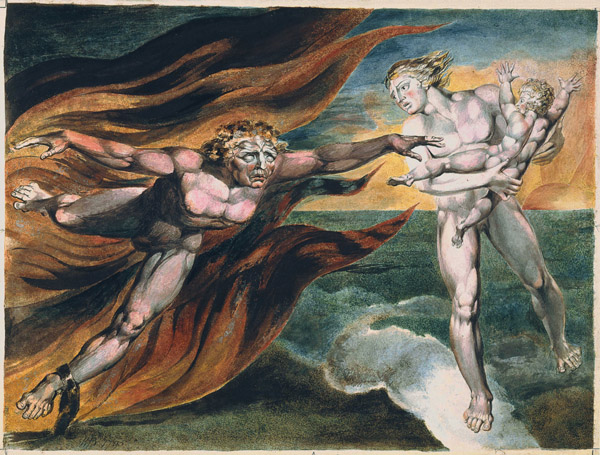
William Blake, The Good and Evil Angels

In the past prayer was able to bring down punishment, rout armies, withhold the blessing of rain. Now, however, the prayer of the just turns aside the whole anger of God, keeps vigil for its enemies, pleads for persecutors. Is it any wonder that it can call down water from heaven when it could obtain fire from heaven as well? Prayer is the one thing that can conquer God. But Christ has willed that it should work no evil, and has given it all power over good. Its only art is to call back the souls of the dead from the very journey into death, to give strength to the weak, to heal the sick, to exorcise the possessed, to open prison cells, to free the innocent from their chains. Prayer cleanses from sin, drives away temptations, stamps out persecutions, comforts the fainthearted, gives new strength to the courageous, brings travelers safely home, calms the waves, confounds robbers, feeds the poor, overrules the rich, lifts up the fallen, supports those who are falling, sustains those who stand firm. All the angels pray. Every creature prays. Cattle and wild beasts pray and bend the knee. As they come from their barns and caves they look out to heaven and call out, lifting up their spirit in their own fashion. The birds too rise and lift themselves up to heaven: they open out their wings, instead of hands, in the form of a cross, and give voice to what seems to be a prayer. What more need be said on the duty of prayer? Even the Lord himself prayed. To him be honor and power forever and ever.

Tertullian, De oratione (On prayer)

Day Bidet #51

I’m on my way to believing:

  1. “I ha’ seen him eat o’ the honey-comb / Sin’ they nailed him to the tree.”
  2. Homeschool your kids. Homeschool your kids. (Related. Related, at least tangentially.)
  3. “Saving faith is better understood as allegiance to Jesus the atoning king.”
  4. You can’t trust the experts. You can’t trust the experts. You can’t trust the experts. You can’t trust the experts. (Related: “Researchers found that while a total of 3,105 people under 18 died from all causes in the UK, only 61 died with a positive PCR test, and only 25 actually died from a SARS-CoV-2 viral infection. The COVID-19 mortality rate was 2 per million in the UK under-18 population.” Related. Related—fun flashback!)
  5. “We won’t know until we get to glory.”
  6. Wholesome. Wholesome. Wholesome. Wholesome. Wholesome. Beautiful. Beautiful. Awesome. Awesome. Awesome.
  7. “I had forgotten that sunset is my business.”

More:

“A young girl … hastily ran to the house in the interval that elapsed between the slowly falling shells. On returning, an explosion sounded near her—one wild scream, and she ran into her mother’s presence, sinking like a wounded dove, the life blood flowing over the light summer dress in crimson ripples from a death-wound in her side, caused by the shell fragment.” (Related.)

“New Testament vocabulary does not constitute a closed system; its backdrop is the Hellenistic world and the classical texts.”

“Heritability was more than a statistical construct, it was a biophysical reality.”

Stravinsky: I cannot now evaluate the events that, at the end of those thirty years, made me discover the necessity of religious belief. I was not reasoned into my disposition. Though I admire the structured thought of theology (Anselm’s proof in the Fides Quaerens Intellectum, for instance) it is to religion no more than counterpoint exercises are to music.

Extravagance in Love

Peter Paul Rubens, “Feest in het huis van Simon de farizeeër” (“Feast in the House of Simon the Pharisee”)

There is a certain extravagance in love. The alabaster phial of perfume was meant to be used drop by drop; it was meant to last for years, perhaps even a life-time; but in a moment of utter devotion, the woman poured it on the head of Jesus. Love does not stop nicely to calculate the less or more; love does not stop to work out how little it can respectably give. With a kind of divine extravagance, love gives everything it has and never counts the cost. Calculation is never any part of love.

William Barclay, The Mind of Jesus

Wish Me Luck

Cecco del Caravaggio, Cacciata dei mercanti dal tempio (Christ Driving the Money Changers from the Temple)

[S]uppose I, a hobbit-like American writer sitting in my armchair, became suddenly curious about the geography around and under 1980-something Piccadilly Circus, which in the intervening decades has been completely remapped. It’s not as easy as you might think to recover even this recent piece of history, even in 2021. Now imagine instead that I am a Greek writer in the late first or early second century, hoping to fabricate a convincing memoir of the pre-70 A.D. life and times of an itinerant Jewish peasant. Wish me luck in this hypothetical, because I’ll need it.

Esther O’Reilly, “What’s the truth about John’s Gospel?”

Day Bidet #50

Though lovers be lost love shall not:

  1. “The father does not demonstrate love in response to his son’s confession. Rather, out of his own compassion he empties himself, assumes the form of a servant, and runs to reconcile his estranged son.” (Related.)
  2. “[P]articipants who are in high positions of power … are less able to adopt the visual, cognitive or emotional perspective of other people, compared to participants who are powerless.” (As Sirius Black said: “If you want to know what a man’s like, take a good look at how he treats his inferiors, not his equals.”)
  3. “Normal everyday consciousness and life is right where God meets me. No show, production, emotional high, ecstatic state, or chemicals needed.”
  4. Where’s the lie? Where’s the lie? Where’s the lie? (Related.) Where’s the lie? Where’s the lie? Where’s the lie?
  5. “When we speak of historical confirmations of the accuracy of the gospels and Acts, this is the type of thing we have in mind.”
  6. “I cannot begin to tell you how many families with young children I see who are unduly stressed precisely because they allow their children to run the show and be the center of the universe.” (Related.)
  7. “It is not the case that God is 50% love and 50% wrath. Rather God is 100% love.”

More:

Carnivore success story. Carnivore success story. Carnivore success story. Vegan…lack-of-success story. (Related: Lift heavy weights to burn more fat. Related.)

“Can Christians Swear or Take Oaths?”

“The totalitarian governments, complicated hierarchies, and repressive social codes that confront the protagonists of YA fiction map well onto the lived experience of 21st century YA life.”

Tolkien: “The essence of a fallen world is that the best cannot be attained by free enjoyment, or by what is called ‘self-realization’; but by denial, by suffering.”

Do the Work

Yes, You Can Trust the Four Gospels. Even When They Conflict.

There is nothing more “humble” about saying that the evidence is insufficient to determine historicity than about saying that the evidence is sufficient. There is an epistemically objective fact of the matter. If you assert that the evidence is insufficient to tell, you should be prepared to defend that just as much as if you said that we can be confident that the event happened or that it didn’t. Downgrading the probability of the proposition that Jesus historically said, “I am the way, the truth, and the life” to .5 is just as much a mistake if the evidence is strong for its historicity than upgrading its probability to something high if the evidence is weak. … Agnosticism needs to be proportionate to the evidence just as much as affirmation or denial. Do the work to decide what the evidence itself really says.

Lydia McGrew

Full quote here.

When it comes to religion, saying “I don’t know” sounds wise and refined, because agnosticism about matters of faith is fashionable. And after all: There are so many different religions, so many arguments for and against each of them, so many (legitimate!) reasons to be skeptical of religious authorities—who are we to say one path is right and the others all wrong?

But notice: Agnosticism about many other matters is decidedly unfashionable. Expressing skepticism about climate change, the 2020 presidential election, “systemic racism,” etc. doesn’t make you sound refined; it makes you sound ignorant—or even hateful. And yet there are so many different views on political and scientific matters, so many arguments for and against each one, so many (legitimate!) reasons to be skeptical of political and scientific authorities…

So: The air of sophistication which surrounds (religious) agnosticism is no more than a mirage—a contingent cultural artifice. It is not, in the main, the product of honest reflection. It is much oftener the product of a deeply solipsistic fear.

Of course, sometimes agnosticism is called for. And sometimes it is not. How can we tell when it is and when it isn’t?

McGrew has the answer: “Do the work to decide what the evidence itself really says.”

Where There Is a Gift, There Is a Gift-giver

Mac Galaxy Wallpaper (76+ images)

Gratitude is a social emotion, the response we feel when we’ve been given a gift. And where there is a gift, there is a gift-giver. As I say in the book, you can’t feel grateful for life and creation and be an atheist, not emotionally. Being awed at the cosmic odds is different from saying “Thank you.”

Richard Beck, “Pascal’s Pensées: Week 17, At Home in the Universe?”

Day Bidet #49

Please take mercy on a soldier from the Florida-Georgia line:

  1. “[T]he modern world wants you godless and unhappy. Because you buy stuff.”
  2. Read this.
  3. “Introduction to 1-2 Chronicles”
  4. “Progress.” “Progress.” “Progress.” (Remember: Technological progress—which is undeniable—can’t make up for social dissolution.)
  5. There is no such thing as “symbolic repentance”—just virtue signaling.
  6. “You never loved the sun in heaven as I have loved the rain.”
  7. “[T]here are some Easter passages in the Synoptics and John that have some unusual language in common. Jesus addresses his disciples as ‘my brothers’ in Matthew 28:10 and John 20:17.” (Related: “Those of us who know the Gospels extremely well know that of course [John 21] is an allusion to Peter’s having boasted that even if all the other disciples abandoned Jesus, he would stand firm. … But … Peter’s boast, and his contrasting himself to the other disciples, appears nowhere in the Gospel of John! … It is in Matthew 26:33 and in Mark 14:29.”)

More:

Clown World. Clown World. (Related. Related. Related. Related.) Clown World. Clown Conservatism, Inc. (Related.) Demon World. (Related.) Demon World. (Related. Related.) Demon World. Black Mirror World (which, yes, is demonic). But a fascinating and beautiful, beautiful, beautiful world nonetheless.

“Romans had a great deal of anxiety about the people they enslaved running away.”

“Whenever this study has been cited, it has always been for the exact opposite of its actual conclusion. … This demonstrates a persistent bias in which the media only reports what people want to hear instead of reporting the truth.”

“[A]bstain from every form of evil.”

Back Behind and Underneath

The Tree of Life: a note |

[B]ack behind and underneath Job’s calculus of guilt and innocence; deeper than tit-for-tat human schemes that would supposedly sort out all the rational, moral reasons for why things happen in the world the way they do; beyond all this, at the heart of everything there is an unending, un-endable generosity, a light that can never be extinguished, an unfathomable source of life and goodness and wisdom. This isn’t merely some impersonal source of inspiration or fortitude that will get you safely through grief and out the other side; this ceaseless gift comes from the presence of the LORD Himself, the God who addresses Job, who speaks with Job, who seeks Job out precisely in his pain and loneliness. Beyond all deserving or undeserving, the LORD comes to Job. The LORD reveals Himself. Job is not given a platitude; he encounters a Person. The LORD is there—in majesty and mercy. And ultimately, in repentance and trust and hope, Job says to God, “I had heard You with my ear, but now my eye perceives You. Therefore, I recant and relent, being but dust and ashes” (42:5-6, NJPS). Job has not had his questions answered, but he has met the One who made him—the One who will open a future for him beyond all deserving or comprehending, the One who asks not for comprehension but for humility and trust.

Wesley Hill, “The Voice from the Whirlwind”

Read the whole thing.

Lewis on Glory

Nature never taught me that there exists a God of glory and of infinite majesty. I had to learn that in other ways. But nature gave the word glory a meaning for me. I still do not know where else I could have found one. I do not see how the “fear” of God could have ever meant to me anything but the lowest prudential efforts to be safe, if I had never seen certain ominous ravines and unapproachable crags. And if nature had never awakened certain longings in me, huge areas of what I can now mean by the “love” of God would never, so far as I can see, have existed. … And not, on the Christian premises, by accident. The created glory may be expected to give us hints of the uncreated; for the one is derived from the other and in some fashion reflects it.

CS Lewis, The Four Loves