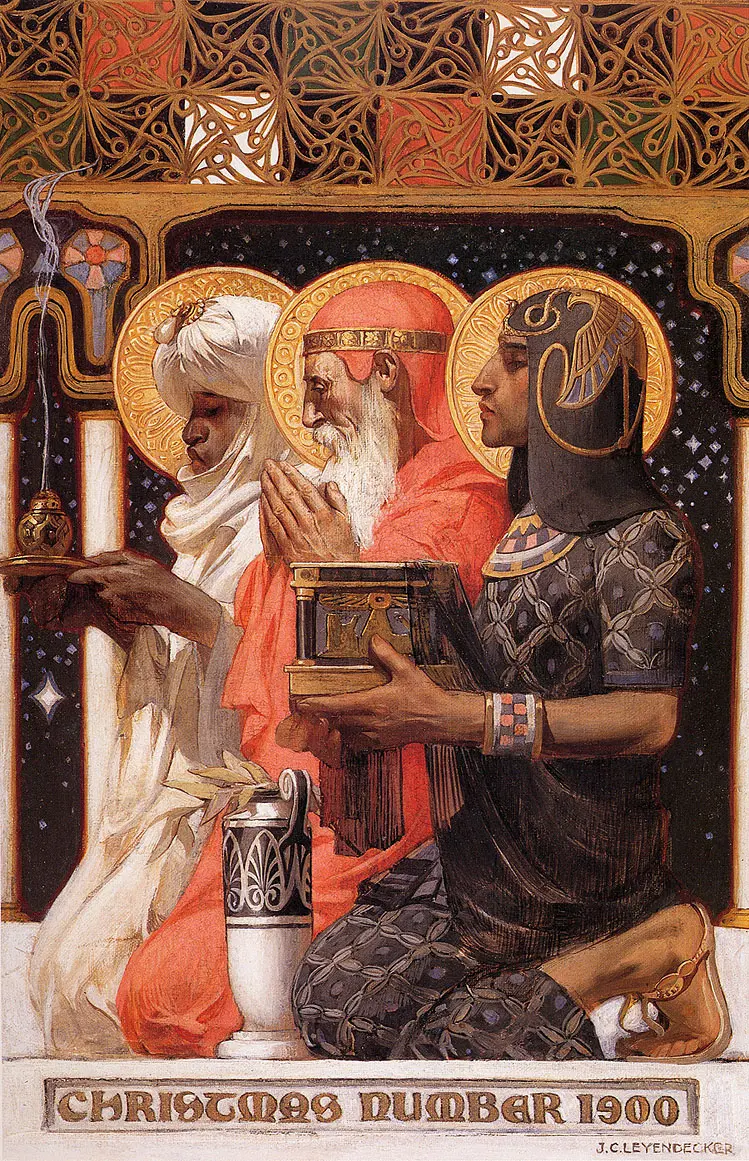
Who had the more truth? The three kings who followed a rumor, or the scribes who remained sitting with all their knowledge?
Søren Kierkegaard
Merry Christmas!

Who had the more truth? The three kings who followed a rumor, or the scribes who remained sitting with all their knowledge?
Søren Kierkegaard
Merry Christmas!
[I]t’s the educated reader who can be gulled. All our difficulty comes with the others. When did you meet a workman who believes the papers? He takes it for granted that they’re all propaganda and skips the leading articles. He buys his paper for the football results and the little paragraphs about girls falling out of windows and corpses found in May-fair flats. He is our problem. We have to recondition him. But the educated public, the people who read the highbrow weeklies, don’t need reconditioning. They’re all right already. They’ll believe anything.
CS Lewis, That Hideous Strength

Now we can see what the modern world is missing, aided by the admirable clarity of the blindsight of BLINDSIGHT. The Anarchist is rightfully devoted to destroying everything in the world, including himself, if in fact there were no truth, goodness, nor beauty in the world, or no way to achieve them. If we are all just programmed meat machines, suicide is the noblest option.
But if there is beauty, even it is ineffable, something never to be captured in words, a mystic feeling elusive as a ghost, then the Occultist is right to eschew all talk of truth and virtue, and right to tolerate any man’s approach to the inapproachable.
But if there is truth, even if it is hard and cold and tinged with bronze, the Cultist is right to impose it on the world, no matter the cost in human suffering, and let all competing truths and claims of other virtues be damned. The only beauty is what serves the Cause.
But if there is virtue, then men must get along with each other, and also go along with each other just enough to maintain the public weal. The talk of truth can be tolerated as long as no violence is done in its name, and beauty is in the eye of the beholder.
But if there is magic, then there is a force in the world which sets the standard of truth and beauty and goodness, and bright magic is both more fair than dark magic, and merits our loyalty. Each man must find that light for himself, because no authority is to be trusted.
But if there are miracles, and I mean miracles from God, then there is an authority, a divine and loving Father who has both the natural authority of a parent and of a creator and of king. If one of those miracles is the Resurrection, then to all these other claims of authority, the divine can also claim the most romantic authority of all: the authority earned by merit. Christ has authority because he earned it by suffering the quest to the bitter end, and rescuing the fair bride from the red dragon. The crown of thorns is his reward.
If there are miracles, there is at once truth and beauty and goodness, for all these flow from the same source.
John C. Wright, “Transhumanism and Subhumanism”

Modernists were indeed revolutionaries. They rejected the notion that art must be rooted in a nation’s history, and they deliberately sought change and experimentation. ‘To every age its own art’ was the founding principle of the Vienna Secession in 1897. It was permissible for art to be ‘ugly’ and to emulate the blunt energy of ‘primitivism’. They were more concerned for truth and doubts than for beauty and certainties, more interested in questions than in answers, more anxious to communicate feelings … than to portray visual reality. … Modernists celebrated disorder and uncertainty. Far from shunning the epithet of elitist, they raised it to a high principle that artists were independent of society and that culture was a sphere unto itself. The gulf that had opened between Modernists and the public was not their fault; it was the public that had lost its aesthetic sense and gone its own way. Nothing could have been more foreign to the Modernists than the idea that they had an obligation to society. Inculcating national pride or providing the public with security, beauty and joy, not to mention a refuge from life’s travails, was not what they had in mind.
Frederic Spotts, Hitler and the Power of Aesthetics

By many objective measures the lives of women in the United States have improved over the past 35 years, yet we show that measures of subjective well‐being indicate that women’s happiness has declined both absolutely and relative to men. The paradox of women’s declining relative well‐being is found across various datasets, measures of subjective well‐being, and is pervasive across demographic groups and industrialized countries.
Betsey Stevenson and Justin Wolfers, “The Paradox of Declining Female Happiness”
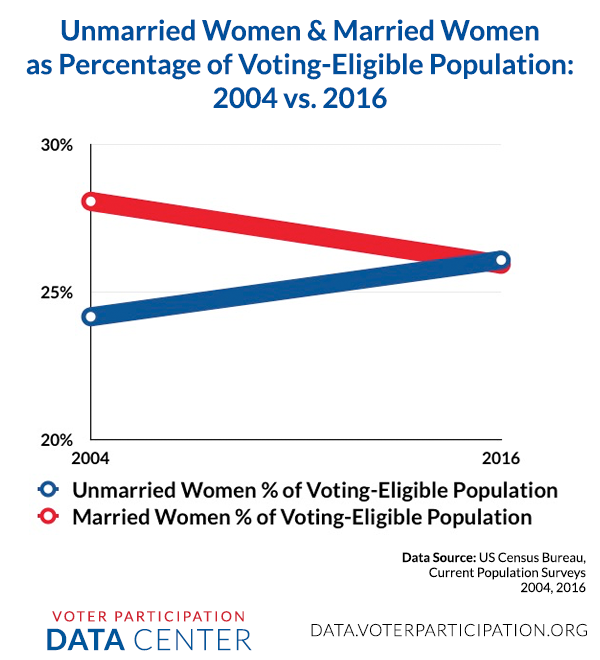
But of course there is no paradox. Women (like men) are much happier married, and yet marriage rates are at their lowest in over a century. Women with 2-4 children (unlike childless woman) grow happier over time, and yet women are having fewer and fewer children.
(And the decline in women’s happiness is even worse than Stevenson and Wolfers realize. “23% of women in their 40s and 50s take antidepressants.” Modern women are unhappier even though their happiness is artificially propped up with drugs. Presumably, they would be even more unhappy otherwise.)
Careers and hookups don’t make most women happy—families do. Until a few decades ago, almost all women understood this. But then second-wave feminism was foisted upon us by the Blue Establishment (did you know Gloria Steinem was bankrolled by the CIA?), and now—”paradoxically”—women are unhappier.
The future is nasty indeed.

Certainly the notion everywhere prevails among us … That the grand panacea for social woes is what we call ‘enfranchisement,’ ’emancipation;’ or, translated into practical language, the cutting asunder of human relations, wherever they are found grievous…. Let us all be ‘free’ of one another; we shall then be happy. Free, without bond or connection except that of cash-payment; fair day’s wages for the fair day’s work; bargained for by voluntary contract, and law of supply-and-demand: this is thought to be the true solution of all difficulties and injustices that have occurred between man and man.
To rectify the relation that exists between two men, is there no method, then, but that of ending it? The old relation has become unsuitable, obsolete, perhaps unjust; it imperatively requires to be amended; and the remedy is, Abolish it, let there henceforth be no relation at all. From the ‘Sacrament of Marriage’ downwards, human beings used to be manifoldly related, one to another, and each to all; and there was no relation among human beings, just or unjust, that had not its grievances and difficulties, its necessities on both sides to bear and forbear. But henceforth, be it known, we have changed all that, by favor of Heaven: ‘the voluntary principle’ has come up, which will itself do the business for us; and now let a new Sacrament, that of Divorce, which we call emancipation, and spout of on our platforms, be universally the order of the day!—Have men considered whither all this is tending, and what it certainly enough betokens? Cut every human relation which has anywhere grown uneasy sheer asunder; reduce whatsoever was compulsory to voluntary, whatsoever was permanent among us to the condition of nomadic:—in other words, loosen by assiduous wedges in every joint, the whole fabric of social existence, stone from stone: till at last, all now being loose enough, it can, as we already see in most countries, be overset by sudden outburst of revolutionary rage; and, lying as mere mountains of anarchic rubbish, solicit you to sing Fraternity, &c., over it, and to rejoice in the new remarkable era of human progress we have arrived at.
Thomas Carlyle, Latter-Day Pamphlets

This is not an isolated incident. There have been hundreds of hate hoaxes across the US in the past several years. The most famous one is probably Jussie Smollett’s, but there’s a long list of other cases; in fact, one researcher “compiled a database of 346 hate-crime allegations and determined that less than a third were genuine.”
Politics is war, and war is as old as mankind (or chimpanzeekind). But hate hoaxes are relatively new. What can they teach us about how political war works?
In real war, with swords or guns, you generally want your side to appear as strong and intimidating as possible. Your goal is to scare your enemy.
In American political war today, you generally want your side to appear as weak and oppressed as possible. Your goal is to demonize your enemy.
And with that goal in mind, hate hoaxes make perfect sense. A hate hoax makes you look weak and oppressed and your enemy, well, hateful. It makes you look like the victim deserving of sympathy—and validates your anger and retaliation against anyone who opposes you.
Hate hoaxes, in other words, exaggerate your enemy’s hatred and power. And in political war, exaggerating your enemy’s hatred and power is the smart thing to do. Most people are anti-hate, so if you can successfully portray your enemy as a hateful oppressor, you can get most people to turn on him. You can make him the target of their outrage and indignation (and hatred). And then you’ve won the political war.
Especially if you’re the Blue Establishment. There are hate hoaxes on both sides (and genuine hatred on both sides), but Blue is the Establishment, Blue dominates American culture, and Blue’s morality is victim morality, so only Blue has been able to turn its hate hoax into a full-fledged Narrative and worldview.
We’re all familiar with the Blue Narrative because, well, we’re all living in it. It’s the hate hoax according to which whites/men/Christians/cops are exclusively and systematically oppressing nonwhites/women/non-Christians/criminals. The Blue Narrative is a hoax not because no such oppression exists—white men have done plenty of awful things throughout history—but because it shamelessly distorts and exaggerates. Which is why millions of Americans are protesting a police brutality “epidemic” which simply does not exist.
(How many unarmed black men would you guess were killed by the police in 2019? Hundreds? Thousands? The answer: as few as nine—and of course the number of unjustified killings is even lower. But the Establishment has convinced half the country that a genocide is underway because it wants us hysterical and under its control.)
(Another case study: What proportion of anti-Semitic hate crimes in New York would you guess were committed by right-wing extremists after Trump’s election? Most? All? The answer: none. “During the past 22 months, not one person caught or identified as the aggressor in an anti-Semitic hate crime has been associated with a far right-wing group.” If you answered “most” or “all,” you have probably been hate hoaxed by the Establishment.)
(Final case study: Have you seen any recent video or photographic evidence of roving bands of “white supremacists” doing anything like this, this, or this—not to mention this? If not, then consider the possibility that you are being lied to about the nature of hatred, violence, and crime in America.)
The truth is that America in 2020 is about as unoppressive a place as has ever existed for nonwhites, women, and non-Christians, and that Reality is much more nuanced than the Blue Narrative admits (and often the opposite of what the Narrative says). The truth is that the Establishment is not ignorant Trump supporters but rich people in Washington, New York, and San Francisco—not white men in general (many of whom are profoundly unprivileged) but woke Blues.
The Establishment, however, has done everything in its power to get you angry at the Great White Bogeyman instead of at it, because the the actual people with actual power want your anger directed at scapegoats (white people, men, cops, “racists”) rather than at them. It’s not hard to see why: The more the powers of this world can control your worldview and anger, the more they can control you.
But I don’t want to be controlled by anyone but God or hysterical and unhealthily angry. I want to be rational and free. For me, and for most of us, that means erring on the side of being less angry, for at least two reasons. The first is that anger is generally bad for you:
Of the Seven Deadly Sins, anger is possibly the most fun. To lick your wounds, to smack your lips over grievances long past, to roll over your tongue the prospect of bitter confrontations still to come, to savor to the last toothsome morsel both the pain you are given and the pain you are giving back—in many ways it is a feast fit for a king.
The chief drawback is that what you are wolfing down is yourself.
The skeleton at the feast is you.
Frederick Buechner, Wishful Thinking: A Theological ABC
The second is that clamping down on anger is a necessary step to seeing the world clearly. It keeps us from rushing to judgment when we hear about the latest incident (which may be a hate crime or a hate hoax—or just an honest mistake). And it allows us to see through the Blue Narrative—or any other narrative—and understand Reality for what it truly is: something quite different from the hate hoax in which we currently live.

[S]ince biblical scholarship has taken up a home primarily in the academy (where learned people speak and write to impress other learned people) rather than in the church (where holy people speak and write to transform others), it is peculiarly susceptible to academic chicanery.
Over the course of my career, I have seen wave after wave of theoretical keys promising to unlock the ancient texts: existentialism, psychology (Freudian, Jungian, Adlerian), structuralism (Marxism of some form or another), post-structuralism (whether Derridean or Foucaultian), the anthropology of honor and shame. They have all over-promised and under-delivered, for they have all missed the heart of the literature, which is religious thought about life before God.
[…]
My problem is with first-world academics using “post-colonialism” as just one more in a series of theoretical perspectives that have, at best, a very limited usefulness in understanding the New Testament. In the case of Paul, in particular, as I have tried to show, all social conditions are adiaphora, and all humans are called to be slaves of God. Paul is not concerned with moving around the furniture of social arrangements. He is much more radical than that. He is concerned with humans being transformed in their very existence so that they can share in the life of God.
Luke Timothy Johnson, Interview with Nijay Gupta

Political/economic ideology is the religion of modernity. Like the adherents of traditional religion, many people find comfort in their political worldview, and greet critical questions with pious hostility. Instead of crusades or inquisitions, the twentieth century had its notorious totalitarian movements. “The religious character of the Bolshevik and Nazi revolutions is generally recognized,” writes Hoffer. “The hammer and sickle and the swastika are in a class with the cross. The ceremonial of their parades is as the ceremonial of a religious procession. They have articles of faith, saints, martyrs and holy sepulchers.”
Bryan Caplan, The Myth of the Rational Voter: Why Democracies Choose Bad Policies
It is easy to recognize the religious character of Bolshevik and Nazi ideology. But of course American Progressivism and nationalism have their own parades, articles of faith, saints, martyrs, and holy sepulchers. Are they any less religious?
It is easy to behold the mote in the Nazi’s eye—harder to consider the beam in our own eye and to ask whether our own political ideologies are any more compatible with Christianity (and Reality) than Bolshevism and Nazism.
But the question must be asked how and why and to what extent Progressivism or nationalism (or moderation, or withdrawal from political life, or anything else) is compatible with the faith. Otherwise, we risk fighting on the wrong side of America’s holy civil war—or fighting on the right side (if there even is a “right side”) in the wrong way.
One of my favorite thinkers, Robin Hanson, likes to say that politics isn’t about policy. If it isn’t about policy, what is it about? Here’s a quick stab at my answer.
In America in 2020, politics more than anything is what reflects people’s deepest values. Many people, especially white Millennials, are much more passionate about their political views than their religious views (not that the two are entirely separable). Even as Americans have become more accepting of marrying across religious and racial lines, they’ve become less accepting of marrying across political lines. This isn’t a fluke; it’s a consequence of the fact that in America today politics is religion.
What is a Trump rally? A revival meeting. What is this chant? A liturgy. Who is George Floyd? A martyr. Who is MLK? A saint. What is “All Lives Matter”? Blasphemy. The social and psychological function of politics is increasingly indistinguishable from that of religion. Shias and Sunnis, Protestants and Catholics, Palestinians and Israelis, Leftists and Trumpists—what’s the difference?
And of course politics involves conflict. Power. Money. Alliances. Even literal violence on the extremes. “War is merely the continuation of politics by other means”—and vice versa. Politics is war.
Politics is religion. Politics is war. So: Politics is holy war.
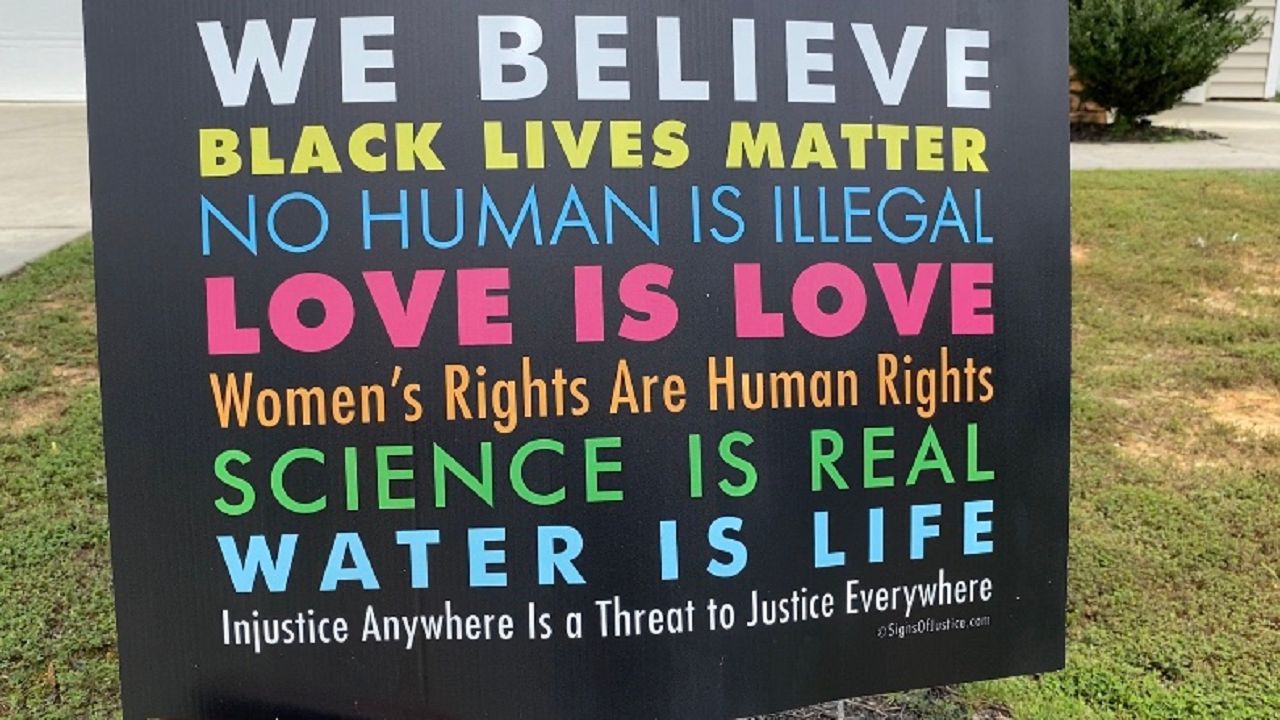
Who are the sides in this war? Not blacks and whites. (You have noticed the white people saying Black Lives Matter, right?) No, the sides in this war are Red and Blue. Not exactly “liberal” and “conservative”—the political landscape is changing (though the Dems and GOP are changing with it). More like coastal elites and flyover country, or Progressives and populists.
Red believes in America First; Blue believes in Social Justice. Red venerates American soldiers; Blue venerates black people. Red hates Blue for hating America; Blue hates Red for being backwards and racist (or insufficiently anti-racist). Red is mostly “middle” (white) America plus (a shrinking share of) white Catholics and Evangelicals; Blue is mostly rich and/or “fashionable” people and most nonwhite Americans. To simplify the socioeconomic and cultural divide greatly, Red vs. Blue is: Middle (the white working class) vs. High (overeducated wealthy elites most of whom are not WASPs) and Low (poor blacks and Hispanics).
Blue controls pretty much all the major cities (where most of the money and power is) and pretty much all the major institutions: corporations (Big Business and Big Gov are on the same side); arts, entertainment, and media organizations (minus Fox and a couple others); universities and most public schools; NGOs; the permanent government (a.k.a. the bureaucracy, a.k.a. “the Swamp”); and so on. Red controls the presidency (for now) and not much else.
Notice that I said that Red hates Blue and that Blue hates Red. And notice that I said Red is Middle and Blue is High and Low. And notice that I said that Blue controls pretty much all the major institutions. What’s the upshot of all that?
The game is not white vs. black. The game is Red vs. Blue. The winners are the Blue Highs. The losers are everyone else: both the (Red) Middles and the Blue Lows.
And the game, of course, is not just a game. The game is war. And since the warring parties are both American, the war is a civil war. So: Politics is holy civil war.
How is this war fought? Not with violence (for the most part). With propaganda. Slogans. Memes. Laws. Judges. Schools. Movies. TV shows. Songs. Tweets. Everything is political now. So everything is a weapon.
This picture of American society is probably different from yours in some respects. If you’re not convinced, try it out and see if it fits. Comment with questions and objections. I’ll do my best to answer them.
Why does any of this matter? Well, if politics is holy civil war, then there are at least a couple reasons Christians should at the very least be worried about public political engagement:
“But isn’t the Church supposed to fight for justice and stand up for the oppressed?” Yes. If you think the only (or main) way for the Church to do that is to get embroiled in the holy civil war, you have been successfully propagandized.

 Brave Ole World